
Search intent categories are the four core ways people frame their search queries: informational, navigational, commercial, and transactional. If your service page is not aligned with the right category, Google will almost always rank a different page in its place.
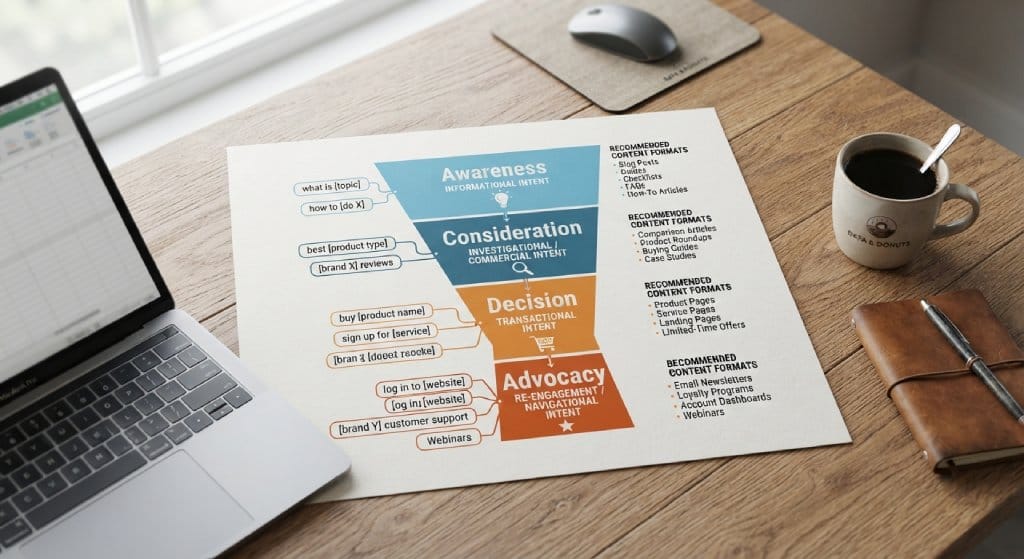
Table of Contents
ToggleKey Takeaways
- There are four types of search intent: informational, navigational, commercial, and transactional.
- Service pages most commonly fail by targeting informational keywords instead of transactional or commercial ones.
- Misreading intent is one of the most common reasons a technically solid page refuses to rank.
- Aligning content format, heading structure, and calls to action to the right intent type dramatically improves ranking potential.
- Keyword research that includes intent classification is far more useful than keyword research based on volume alone.
- Local service businesses in the Philippines and internationally can both benefit from intent-first content strategy.
What the Four Types of Search Intent Actually Mean for Your Pages
Most SEO resources define intent in one sentence and move on. That is not enough when you are trying to figure out why a well-written service page sits on page three while a thin blog post outranks it. The distinction between intent types becomes critical once you realize Google is not just matching keywords; it is matching purpose.
Here is a quick breakdown of all four types before going deeper on how they affect service pages specifically:
|
Intent Type |
What the User Wants |
Typical Content Format |
|
Informational |
An answer, explanation, or education |
Blog post, how-to article, FAQ |
|
Navigational |
A specific website or brand |
Homepage, brand landing page |
|
Commercial |
To compare options before buying |
Review, comparison, list article |
|
Transactional |
To take an immediate action |
Service page, product page, booking form |
Understanding which column your target keyword belongs in is not optional. It is the starting point of every content and ranking decision you make afterward.
Navigational intent is narrower. Searches like “Bukidnon SEO Specialist website” or “Jesrell Belmes SEO” indicate someone already knows who they are looking for. These queries land on homepages or branded landing pages, not generic service content.
Commercial intent is the research phase. People search like “best SEO consultant Philippines” or “SEO agency vs. freelancer” tell you someone is comparing options and building a shortlist. This is where listicles, comparison articles, and review-style content perform well.
Transactional intent is the closest to a decision. “Hire SEO specialist Bukidnon,” “SEO audit service Philippines,” or “book on-page SEO consultation” all signal someone who wants to act now. This is the category your core service pages need to satisfy.
How Service Pages Misread Intent and Pay for It
The most common intent mismatch in SEO for service businesses is targeting informational keywords on transactional pages. It happens more often than most practitioners admit, and it is a key reason why pages built for on page seo fail to rank despite being technically clean.
Imagine a service page for website audits that opens with a long explanation of what an audit is, lists every technical term involved, and only gets to the service offering in the fourth paragraph. The keyword it targets might be “what does an SEO audit include.” That is an informational query. Google looks at that search, sees that blog posts and educational resources consistently satisfy it, and ranks those instead of a service page.
The fix is not to stuff more keywords into the page. The fix is to re-examine the keyword, confirm its intent type, and match the page’s format, headline structure, and primary call to action to what that intent demands.
Here are three common patterns where intent mismatch kills service page rankings:
- Informational keyword on a transactional page.
- The page explains too much and sells too little. Google reads the format as educational content and ranks it against blog posts, where it loses.
- Transactional keyword on an informational article.
- The blog post tries to close a deal. Readers who came for education feel pressured, bounce quickly, and the page suffers in engagement signals.
- Commercial keyword buried in a generic service page.
- The page does not acknowledge the comparison stage. There are no differentiators, no trust signals, no clear reason to choose you over others. The user bounces to a comparison article that actually answers their “which one should I pick” question.
An experienced SEO Specialist sees this pattern regularly when working with service-based businesses. The issue is not usually the writing quality or the technical setup. It is that the page was built around what the business wanted to say rather than what the searcher came to find.
How to Correctly Align Content to Each Intent Type
Getting the alignment right starts during the initial stages of your SEO strategy, not during writing. Before a single word goes on the page, you need to know what intent your target keyword carries. The practical method is simple: search the keyword yourself, look at the top five results, and classify what Google is already rewarding.
If the top five search engine results are all how-to blog posts, Google has classified that keyword as an informational intent keyword. A service page will not beat those results no matter how polished it is. Either shift the keyword to a blog post or find a transactional variation of the topic that your service page can legitimately compete for.
For each intent type, the page needs to deliver a specific experience:
Informational pages should answer the question directly in the first paragraph (which is exactly what featured snippets reward), use clear subheadings for each sub-question, and avoid heavy sales language. A light mention of related services at the end is acceptable, but it cannot dominate the page.
Navigational pages need fast load times, clear brand identity signals, and prominent contact or action pathways. Someone searching for your brand by name already knows enough to reach out; the page just needs to make that action frictionless.
Commercial pages need comparison elements, clear differentiators, trust signals like credentials or client outcomes, and a tone that respects the fact that the reader has not made a decision yet. Pushing for an immediate sale on a commercial-intent page often backfires.
Transactional pages should lead with the offer, keep the explanation concise, and place the call to action in multiple positions throughout the page. The reader already knows what they want; you are removing barriers, not building awareness.
One underused technique is creating intent-specific content clusters. A transactional service page at the center, surrounded by informational and commercial blog posts that link back to it, allows you to capture search queries at every stage of the decision journey and funnel that traffic toward the page that actually converts.
Where Local and International Businesses Both Go Wrong
The intent mismatch problem is not unique to any one market. Whether you are serving clients in Malaybalay City, Bukidnon, or working with businesses in the United States, the underlying issue is the same: content is written for the business owner’s knowledge level, not the searcher’s query intent.
Local service businesses in the Philippines face a compounding challenge. Many are building their web presence for the first time, which means they are often publishing content without a clear keyword strategy at all. A home service company in Bukidnon might write a blog post titled “Our Cleaning Services,” which has no search demand, zero intent alignment, and no path to organic traffic.
Understanding search intent categories gives local business owners a framework to make smarter publishing decisions before they waste effort on content that will never rank.
For international markets, the challenge tends to be the opposite. There is usually more content, more competition, and a stronger understanding of SEO basics. But the error that persists even at a sophisticated level is optimizing for search volume without validating intent. A keyword with high monthly searches might look attractive until you realize the top ten results are all Wikipedia-style informational pages and your service page has no realistic chance of ranking there.
At the independent practice level, Jesrell Belmes applies an intent-first framework on every client project, whether that client is a Philippine local business or an international service brand. The approach does not change: classify the intent before writing the page, then build the content format around what that intent demands.
Practical Steps to Audit Your Pages for Intent Alignment
If you already have service pages live and are not satisfied with where they rank, the most productive starting point is an intent audit rather than a content rewrite. Here is how to approach it:
- List every service page URL and its primary target keyword.
- Search each keyword manually and note the content type of the top five results.
- Compare what Google is rewarding against what your page delivers.
- Flag every page where the format mismatch is clear.
- Decide whether to reposition the keyword, reformat the page, or build a new supporting article with the mismatched keyword to feed traffic back to the service page.
- Prioritize changes by traffic potential and how far off the current alignment is.
This process is particularly useful when you have a page that receives impressions in Google Search Console but almost no clicks. High impressions with low click-through rates often signal that your page is appearing for the right general topic but delivering the wrong content type, and users can see that in the title and meta description before they even land on the page.
Intent alignment is also directly connected to how you write meta descriptions and title tags. A transactional page should have a title and meta that reflect action and availability. An informational page should promise an answer. Getting those signals right at the snippet level improves click-through rate before anyone even reads your content.
The Bottom Line on Search Intent Categories
Search intent categories are not a theoretical SEO concept reserved for advanced practitioners. They are a practical diagnostic tool that explains why pages rank or fail to rank, often more accurately than any technical audit alone.
If you are building or refining service pages without confirming the intent behind each target keyword, you are optimizing in the dark. Start every content project by asking what the searcher actually wants, confirm it by looking at what Google already ranks, and then build a page that matches that expectation precisely.
For service-based businesses in the Philippines and internationally, working with an SEO specialist who applies intent classification from the start means your content is built to rank from day one rather than rebuilt after it fails. The next step is to audit your current service pages against the four intent types and identify where the misalignment is costing you traffic.
Things to Know
- Google determines intent from the collective behavior of searchers, not from the keyword alone. The same word can carry different intent in different contexts, so always validate by checking what content formats currently rank.
- Intent can shift over time. A keyword that was informational two years ago may now carry commercial intent as a market matures and more buyers enter the space. Regular audits of your target keywords are necessary, not a one-time task.
- A single page can partially satisfy two intent types, but it must prioritize one clearly. Trying to serve informational and transactional intent equally on the same page usually results in the page ranking poorly for both.
- Meta descriptions and title tags are intent signals too. If your title reads like a blog post but the page is a service offering, searchers will skip it in the results, even if it ranks. Your snippet must match the intent your page is built to satisfy.
- Many Philippine small businesses unknowingly publish or create content with no target keyword at all, which means intent alignment is impossible from the start. Defining the keyword before writing is the prerequisite to everything else.
- Search engines like Google use machine learning models to classify intent at scale. This means keyword stuffing no longer overrides intent signals. The overall structure, format, and user behavior on your page all contribute to how Google categorizes it.
Where to Go From Here With Search Intent Categories
Understanding search intent categories is the clearest lens you can apply to a content strategy that is not delivering results. It cuts through guesswork about why pages rank or fail and gives you a concrete, actionable framework to work from. Every service page you publish, every blog post you plan, and every keyword you target becomes a more deliberate decision when you know which intent type you are serving.
The practical next step is straightforward: pull up your most important service pages, search their target keywords one by one, and compare what Google ranks against what you published. Where there is a mismatch, you have found the real reason the page is underperforming. From there, you can reposition the keyword, reformat the page, or build supporting content that captures adjacent intent and routes traffic toward your core offer. If you want a structured approach to this process, Bukidnon SEO Specialist works directly with service-based businesses to audit content, classify keywords by intent, and rebuild page strategy from the ground up. Reach out at bukidnonseo.pinoyseosites.com to get started.